📅17 September 2026 | 9:00 – 17:00 CEST | Venue Auditório da Sede Nacional da Ordem dos Engenheiros, Lisbon | Hybrid | English & Portuguese | Free CRACoWi consortium partner SevenShift will be attending “CRA Standards Unlocked – EU Tour in Lisbon,” a hybrid workshop dedicated to helping SMEs understand, prepare for, and comply with the EU Cyber Resilience Act (CRA). This whole-day event is organised by the EU-funded projects CYBERSTAND.eu and STAN4CRA.eu, with the support of the Ordem dos Engenheiros.
The session brings together rapporteurs from the European Standardization Organizations (ETSI and CEN-CENELEC), who will present the latest drafts of harmonised CRA standards currently under development and gather feedback directly from attendees.
What you can expect
A clear breakdown of what the CRA requires and what it means in practice for SMEs
Direct insight into which standards matter and how they support compliance
Presentations from CRA standards rapporteurs on the state of ongoing standardisation work
An overview of compliance tools, practical guides, and funding opportunities available through CRA-related EU-funded projects
Practical guidance tailored to SMEs on how CRA requirements translate into product development and conformity assessment processes
Pablo Endres from SevenShift will represent CRACoWi at the event, sharing insights from the project’s work on the Compliance Wizard and present a Bunkai demo as part of the CRACOWi toolchain.
If you’re attending, we’d love the opportunity to connect – stop by and say hello.
CRACoWi is launching a new workshop series built directly around the project’s real-world use cases – grounding CRA compliance in the day-to-day experience of the organisations actually living it, rather than presenting the regulation in the abstract.
Cybersecurity affects us all – including small and medium-sized enterprises:
📅 2 September 2026 ⌛11:00-12:00 CEST 📍Online, free
This first session features Erminas, a software SME building solutions for industrial digitalisation and one of CRACoWi’s use case partners. Speaking from first-hand experience, Erminas shares what it actually takes to respond to a security incident without a dedicated security department and how the Cyber Resilience Act (CRA) can turn that experience from chaotic firefighting into a structured, manageable process.
Rather than a theoretical overview of the regulation, this online workshop walks through a realistic incident scenario step by step, showing how a few practical tools and habits (not a large security organisation) can meet the CRA’s core demand: traceability.
What you’ll learn:
Why SMEs carry the same cybersecurity responsibility as large enterprises, with far fewer resources
A real-world walkthrough of responding to a vulnerability: using an SBOM to scope affected products, checking patch status, applying a lightweight threat model, and communicating clearly with customers
Practical, low-overhead practices – Security Champions, regular awareness training, and frameworks like the NIST Cybersecurity Framework – for building traceability without building a full security department
Why structured processes reduce stress internally and build trust externally, especially in critical moments
Who should attend
Founders, engineering leads, and product teams at SMEs developing or maintaining software or connected products, especially those without a dedicated cybersecurity function and looking for realistic, teamwork-based ways to prepare for CRA compliance.
The presenter: Jonas Gerlach
Cybersecurity Team Lead & IIoT Developer with 8 years of hands-on experience designing, implementing, and securing industrial systems. Passionate about bridging operational technology (OT) and information technology (IT), leading technical teams, and delivering secure, scalable IIoT solutions.
Save the date and register!
📅 2 September 2026 ⌛11:00-12:00 CEST 📍Online, free
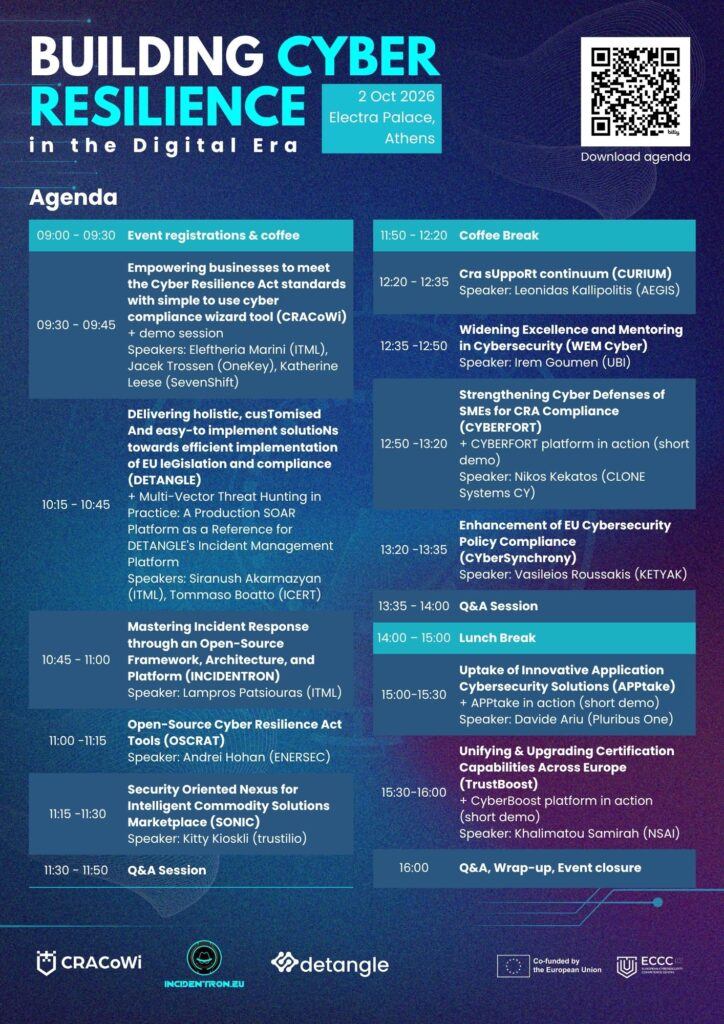
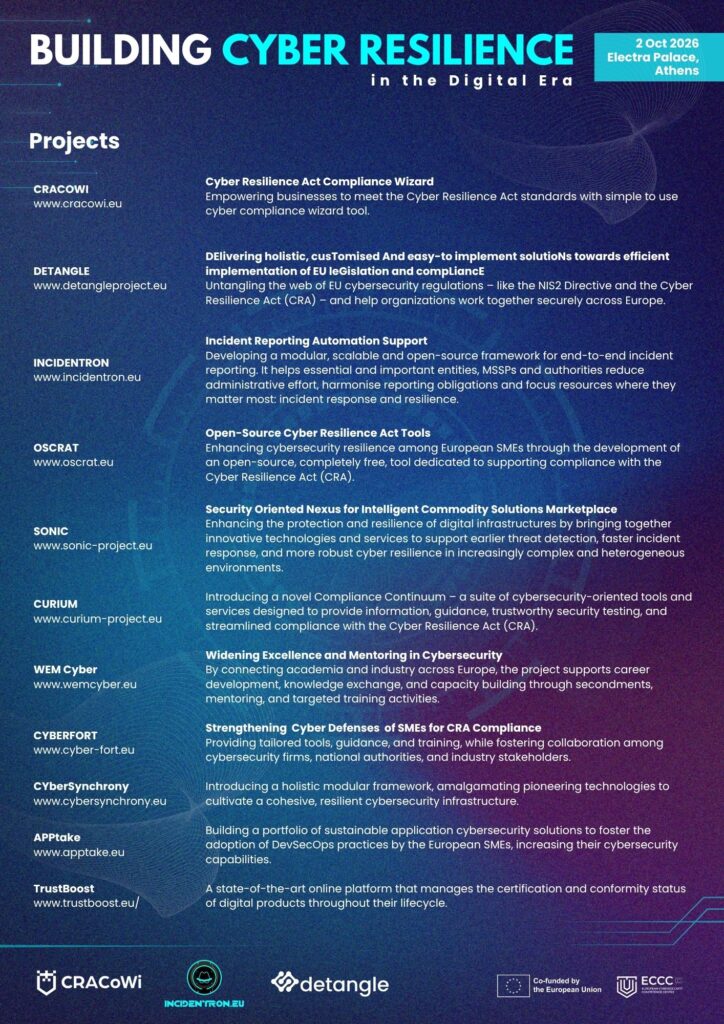
The EU cybersecurity regulatory landscape is evolving fast – and organisations across every sector are being asked to keep pace. Building Cyber Resilience in the Digital Era is a high-impact workshop organised by the EU-funded projects CRACoWi, DETANGLE, and INCIDENTRON, bringing together policy, practice, and peer projects for a single day of focused, practical exchange.
The event centres on three interconnected themes shaping the future of digital resilience in Europe:
NIS2 compliance – what implementation really looks like in practice
Cyber Resilience Act (CRA) enforcement – what to expect as the regulation takes hold
Collaborative, cross-border cybersecurity incident response – how sectors and countries can work together more effectively when it matters most
This is not a theoretical policy briefing. It’s a working session designed to give attendees concrete tools, honest insights from the field, and direct access to the people building solutions to help organisations comply and stay resilient.
What You Will Gain
The workshop will provide practical guidance, real-world insights, and interactive discussions to help organisations strengthen resilience and meet evolving EU cybersecurity obligations. It moves beyond theory to deliver actionable guidance for organisations navigating the new EU cybersecurity regulatory landscape – whatever stage of the compliance journey they’re at.
What to Expect
Presentations from peer EU-funded projects See the tools and services being developed across Europe’s cybersecurity project landscape, and learn how relevant stakeholders can put them to use to strengthen readiness and achieve compliance.
Expert-led discussions A special focus on the practical challenges of NIS2 implementation, expectations around CRA enforcement, and strategies for effective cross-sector, cross-border collaboration in incident management.
Active participant engagement Ask questions, engage with experts and peers, and take part in an open survey and discussion to share your concerns, priorities, and interest in testing the projects’ solutions.
Networking lunch A valuable opportunity to continue the conversation and build lasting connections within the cybersecurity community.
Who Should Attend
This event is open to a broad audience, including:
SMEs, startups, and enterprises
Business leaders and decision-makers
Cybersecurity professionals
Legal and compliance experts
Regardless of sector, any organisation seeking to better understand and prepare for EU cybersecurity regulations will benefit from participating.
Whether you’re leading compliance efforts, shaping strategy, or working on the ground to strengthen your organisation’s cyber resilience, this is a chance to learn directly from the projects building Europe’s cybersecurity toolkit – and to help shape what comes next.
📅 Friday, 2 October 2026 🕘 09:00 – 16:00 📍 Electra Palace Athens – 18-20 N. Nikodimou str, 10557 Athens, Greece 🌐 Language: English
The Cyber Resilience Act (CRA) is increasingly becoming a topic of discussion among companies across Europe. While organisations are working to understand the new requirements, many are asking a more fundamental question: how can they develop products that remain secure and trustworthy throughout their lifecycle?
To support this transition, CRACoWI consortium partner erminas GmbH will participate in the upcoming German-language webinar organised by IHK Oldenburg in cooperation with CYBERsicher – Transferstelle Cybersicherheit im Mittelstand.
📅 19 June 2026, 10:00 – 12:00 AM CEST | online
During the webinar, Dr. Yvette Teiken (erminas GmbH) and Dr. Matthias Kampmann (EASY.CRA) will provide both a regulatory overview and practical perspectives on implementing the CRA.
Participants will gain insight into:
what the CRA regulates and who it affects;
why the European Union is introducing these requirements;
practical challenges related to Software Bills of Materials (SBOMs), vulnerability management, and documentation obligations;
pragmatic approaches for integrating CRA requirements into existing processes.
The session is aimed at SMEs with digital products, machinery and plant manufacturers, IoT manufacturers, and professionals working in IT, product development, and compliance who want to prepare for the CRA in a structured and practical way.
For CRACoWI, participation in events such as this reflects the project’s commitment to sharing knowledge beyond the consortium, engaging directly with industry stakeholders, and contributing to the broader European effort to help organisations navigate the transition towards CRA readiness.
👉 Further information and registration are available via the IHK Oldenburg event page:MORE INFO & REGISTRATION
Understanding the scope of the Cyber Resilience Act (CRA) is one thing; meeting its requirements in practice is another.
As the CRA prepares to replace the cybersecurity requirements under the Radio Equipment Directive from December 2027, manufacturers are entering a new phase of readiness. The challenge is no longer just understanding the regulation, but translating legal obligations into compliant products, practical processes, and demonstrable evidence.
To support organisations on this journey, the CRACoWi project invites you to join the next session of the CRAcademy webinar series From Pain Points to Market Readiness – How CRA Tools Simplify Compliance, on 25 June 2026, at 11 AM CEST.
This practical webinar focuses on the reality of CRA implementation. Drawing on experiences from the field, it explores the recurring issues that often delay manufacturers on their path to compliance and demonstrates how a new generation of CRA tools can transform slow, manual activities into structured and repeatable processes.
Participants will gain insight into some of the most common pain points organisations encounter, including incomplete interface inventories, cryptography gaps, and documentation that cannot be easily verified. The session will show how these challenges can be addressed in ways that are actionable for product teams and aligned with the expectations of the regulation.
Designed as a bridge between regulation and engineering reality, the webinar will help attendees better understand what practical CRA readiness looks like and how organisations can prepare efficiently for market placement and future certification activities.
This session is particularly relevant for:
Manufacturers of connected and digital products;
Engineers, system architects, and product security teams;
Product managers and compliance professionals translating requirements into implementation;
SMEs preparing for CRA implementation and certification. What will you learn?
By attending, you will:
Understand why security-by-design sits at the heart of the CRA;
See who is responsible for what across manufacturers, consultants, and notified bodies;
Recognise the common pain points that lead to costly delays and understand why they occur;
Learn how CRA tools reduce manual, error-prone work into repeatable processes;
Get direct answers to your questions during the live Q&A session.
📅 26 June 2026 🕚 11:00 AM CEST | ONLINE
Participation is free of charge.
👉 Register today and take the next step from compliance pain points to market readiness.
Originally from New Zealand and now based in Cologne, Germany, Katherine brings a unique and practical perspective to cybersecurity. After retraining in her forties to become an IT specialist for system integration, she combines hands-on technical experience with an understanding of the real-world challenges organisations face when implementing cybersecurity requirements.
As part of the CRACoWi project, SevenShift contributes to raising awareness about the Cyber Resilience Act and developing practical tools to support compliance. Katherine’s work focuses on helping bridge the gap between regulatory expectations and engineering reality, making complex requirements more understandable and actionable for manufacturers and SMEs alike.
Outside of work, she enjoys parenting a teenager and exploring how technology connects to everyday life.
If you are looking for practical guidance on moving from understanding the CRA to implementing it, this webinar is designed for you.
Participation is free of charge.
👉 Register today and take the next step from compliance pain points to market readiness.
On 12 May 2026, the CRACoWi consortium partner SevenShift participated in the meeting of the Cybersecurity Competence Group titled “Cyber Resilience in Practice: Strategies for a Secure Digital Future”, held in Cologne, Germany.
The event gathered cybersecurity experts, industry representatives, and practitioners to discuss current challenges related to cyber resilience, the evolving threat landscape, and the practical implementation of the Cyber Resilience Act (CRA).
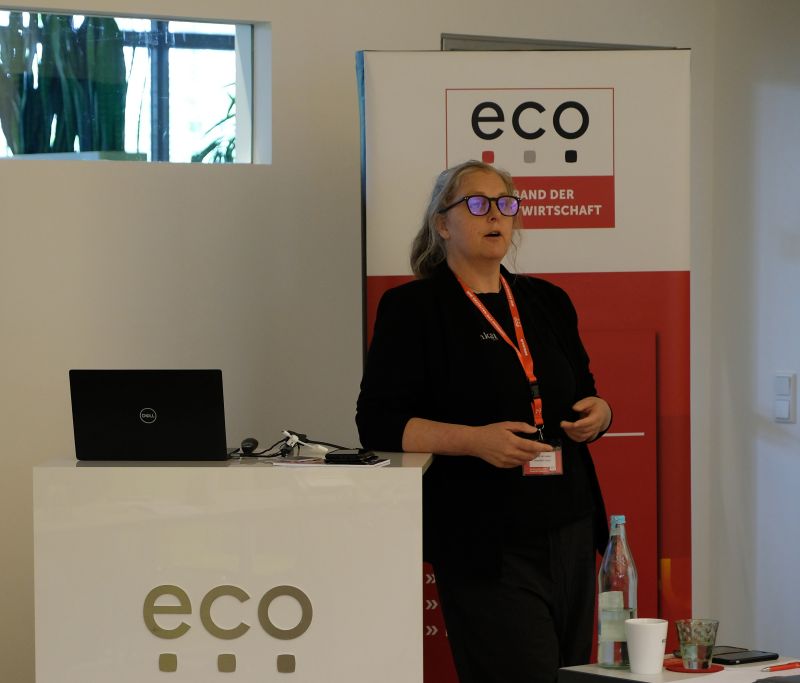
During the session “The Cyber Resilience Act: Legal Framework and Practical Experience”, Katherine Leese from SevenShift (SES) contributed to the discussion by sharing practical experiences from CRA compliance testing and presenting CRA-related tools developed through EU-funded initiatives. As part of the presentation, Katherine introduced the CRACoWi Wizard, highlighting how the project supports organisations in understanding and implementing CRA requirements in practice. Complementary tools developed within other CRA Cluster projects were also presented, underlining the importance of collaboration and alignment between related initiatives.
The discussion addressed several important topics linked to CRA implementation, including reporting obligations and deadlines, responsibilities across the supply chain, security-by-design principles, lifecycle responsibility, and practical challenges organisations face when preparing for compliance.
The meeting also explored broader cybersecurity resilience topics beyond regulatory compliance itself. Discussions focused on the changing threat landscape, including stolen credentials, infostealer malware, residential proxy usage, and increasingly rapid attack execution following successful infiltration. Additional presentations addressed automated vulnerability management, CSAF, and security.txt as important mechanisms for more structured and scalable vulnerability communication.
Participation in events such as this supports CRACoWi’s ongoing efforts to exchange practical knowledge, engage with cybersecurity communities, and strengthen cooperation with related initiatives working on CRA implementation and cyber resilience across Europe.
CRACoWi recently participated in the Cluster Synergies Webinar held on 22 April 2026, an event that brought together EU-funded cybersecurity projects to exchange insights, present ongoing work, and explore areas of alignment.
While such events are often framed as dissemination activities, their real value lies in something deeper – connecting initiatives that are addressing the same regulatory and technical challenges from different angles.
As the Cyber Resilience Act (CRA) moves closer to full implementation, the landscape of tools, methodologies, and support mechanisms across EU projects is rapidly expanding. Without active collaboration, this risks becoming fragmented. The Cluster Synergies Webinar is one of the spaces where this fragmentation can be addressed early – through open exchange, comparison of approaches, and identification of complementarities.
The development of tools supporting CRA compliance
The current progress and direction of the project
The CRAcademy, which provides structured training and practical guidance to help organisations better understand and implement CRA requirements
The discussion confirmed a recurring point across projects: organisations are not lacking awareness of the CRA – they are lacking clarity on how to act. This is where coordinated efforts between projects become essential. Each initiative contributes a different piece – whether technical tools, training, certification support, or implementation guidance – and together they form a more complete ecosystem.
Engaging with other EU initiatives also opens the door to joint dissemination, shared learning, and potential integration of approaches, ultimately increasing the impact of all projects involved.
📅21 May 2026 | 8:45 – 15:30 CEST | Venue DiHubMT, Malta | Hybrid | English | Free
The CRACoWi project will take part in the upcoming CRA Cluster event in Malta, organised as part of the Cyberstand`s EU Tour under the theme “CRA Standards Unlocked.”
This event brings together key stakeholders from EU-funded projects, industry, and standardisation bodies to discuss the implementation of the Cyber Resilience Act (CRA) and the role of standards in supporting compliance.
Through its participation, CRACoWi will contribute to discussions on how to translate CRA requirements into practical tools and approaches for manufacturers and SMEs. The event provides an opportunity to exchange knowledge, explore synergies with related initiatives, and strengthen collaboration within the CRA ecosystem.
Participation in such events is an important part of CRACoWi’s activities, ensuring that project results remain aligned with real-world needs and contribute to a coordinated European approach helping organisations better understand, prepare for, and implement CRA requirements in practice.
Meet the CRACoWi partners – ITML, Seven Shift and Tiko Pro – a the InCyber forum 31 March – 2 April, Pavilion Europe – booth E20-8A.
The CRACoWi project will be showcased at the InCyber Forum Europe 2026, one of Europe’s leading events dedicated to cybersecurity and digital trust. Bringing together thousands of experts, policymakers, and industry leaders, the Forum serves as a key platform for addressing the most pressing challenges in today’s digital landscape and strengthening cooperation across the European cybersecurity ecosystem.
CRACoWi partners ITML, SevenShift, and Tiko Pro will be present at the Pavilion Europe (Booth E20-8A), where they will introduce the project and engage with stakeholders from across the cybersecurity and innovation community.
As the Cyber Resilience Act (CRA) introduces new mandatory cybersecurity requirements for digital products in the EU, CRACoWi plays an important role in supporting organisations, especially SMEs, in navigating compliance. Through its Compliance Wizard, the project provides a practical, step-by-step approach to understanding and implementing CRA obligations.
The InCyber Forum offers a valuable opportunity to exchange knowledge, explore collaboration opportunities, and connect with organisations shaping the future of cyber resilience in Europe.
We invite you to meet the CRACoWi team at the booth and learn more about how the project is contributing to a more secure and trusted digital environment.